
 English
 Español
 Português
Troy, Turkiye

The Legend of Troy
The ancient city of Troy is world-famous thanks to one of history's greatest legends—the Trojan War, immortalized by the Greek poet Homer in his epic masterpiece, The Iliad.
According to Greek mythology, the war began when Paris, Prince of Troy and son of King Priam, was asked to award the Golden Apple of Discord to the most beautiful goddess among Hera, Athena, and Aphrodite.
Each goddess attempted to influence his decision by offering him a remarkable gift:
- Athena promised wisdom and victory in battle.
- Hera offered power and kingship.
- Aphrodite promised him the love of the most beautiful woman in the world.
Paris chose Aphrodite, who introduced him to Helen, the wife of Menelaus, King of Sparta. When Paris brought Helen to Troy, the legendary conflict known as the Trojan War began and, according to tradition, lasted for ten years.
The Trojan War
The most famous events of the war were recorded by Homer in The Iliad.
Among its legendary episodes are:
- The death of Patroclus, Achilles' closest companion.
- Achilles' revenge against Hector, Prince of Troy.
- The death of Achilles at the hands of Paris.
- The construction of the legendary Trojan Horse.
According to tradition, the Greek army pretended to sail away, leaving behind an enormous wooden horse outside the city walls.
Believing it to be a symbol of victory, the Trojans brought the horse into the city. During the night, Greek warriors hidden inside emerged, opened the city gates, and allowed the Greek army to enter, leading to the fall of Troy.
The Discovery of Troy
For centuries, many believed that Troy existed only in legend.
Everything changed in 1870, when the German archaeologist Heinrich Schliemann began excavations at Hisarlık Hill, near Çanakkale.
His discoveries revealed an extraordinary succession of ancient cities built one upon another, confirming that the site had been continuously inhabited for thousands of years.
Subsequent archaeological research identified nine major settlement layers, now known as Troy I through Troy IX.
The Archaeological Layers of Troy
Troy I (3000–2500 BC)
The earliest settlement consisted of a small fortified town surrounded by defensive walls.
Its houses were built from stone and mudbrick before the city was eventually destroyed by a devastating fire.
Troy II (2500–2200 BC)
This settlement was larger, wealthier, and more advanced.
Its inhabitants worked with copper, gold, and silver, while Troy's strategic location encouraged trade between Asia and Europe.
Like its predecessor, Troy II was also destroyed by fire.
Troy III, IV, and V (2200–1800 BC)
These layers represent smaller settlements but demonstrate the continuous human occupation of the region.
Troy VI (1800–1275 BC)
Troy VI developed into a powerful city protected by massive stone fortifications.
Its influence extended across Anatolia and the Aegean world.
The city was eventually destroyed by a major earthquake.
Troy VII (1275–1200 BC)
Following the earthquake, the inhabitants rebuilt the city.
Many archaeologists believe that Troy VII may be the city described by Homer.
Excavations reveal evidence of siege, fire, and violent destruction consistent with military conflict.
Troy VIII (700–350 BC)
During the Greek period, Troy became a modest commercial center and an important pilgrimage destination.
Troy IX (350 BC–AD 400)
The final settlement belongs to the Hellenistic and Roman periods, when Troy experienced a new era of prosperity.
What to See in Troy
Today, the archaeological site of Troy is one of Turkey's most important historical attractions.
Highlights include:
- Ancient defensive walls
- Residential remains from different historical periods
- The Roman theater
- Ancient sanctuaries
- The South Gate
- The impressive fortifications of Troy VI and VII
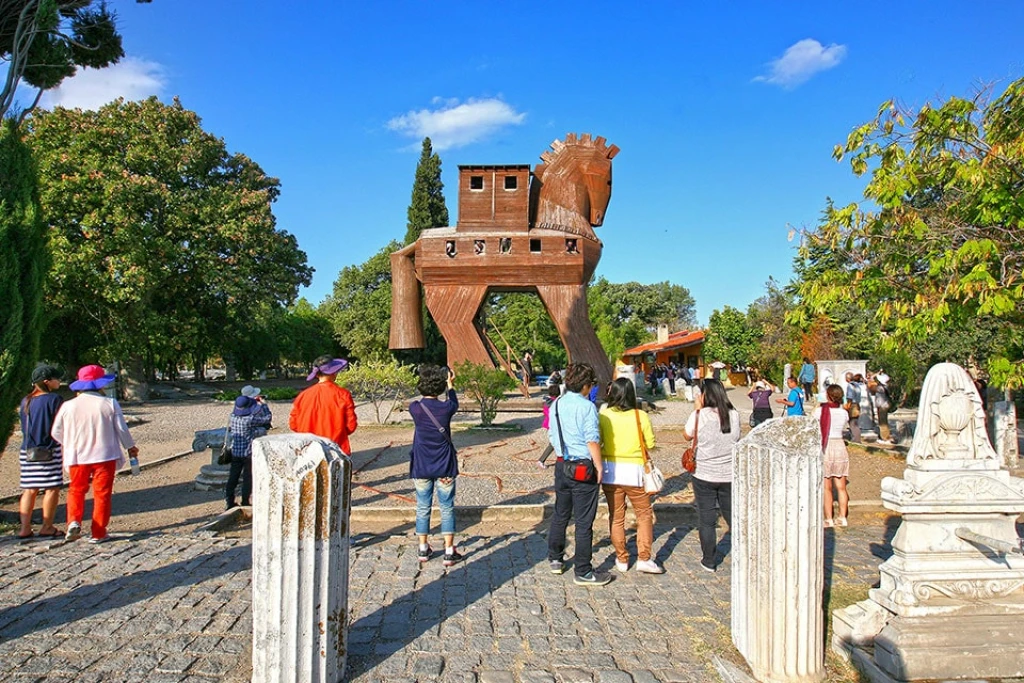
- The famous Trojan Horse
The Trojan Horse
The modern reconstruction of the Trojan Horse has become the most recognizable symbol of the archaeological site.
Thousands of visitors come every year to photograph this iconic structure, which commemorates one of the greatest stories ever told in world literature.
Throughout the year, cultural events and educational activities continue to celebrate the legacy of the legendary city.
A World Heritage Treasure
Troy is one of the world's most significant archaeological sites.
Its unique combination of history, archaeology, and mythology attracts travelers, historians, researchers, and culture enthusiasts from across the globe.
Visiting Troy is an unforgettable journey to the place where legend and history meet in the heart of Anatolia.
Our partners