
 English
 Español
 Português
The Ancient City of Pergamon

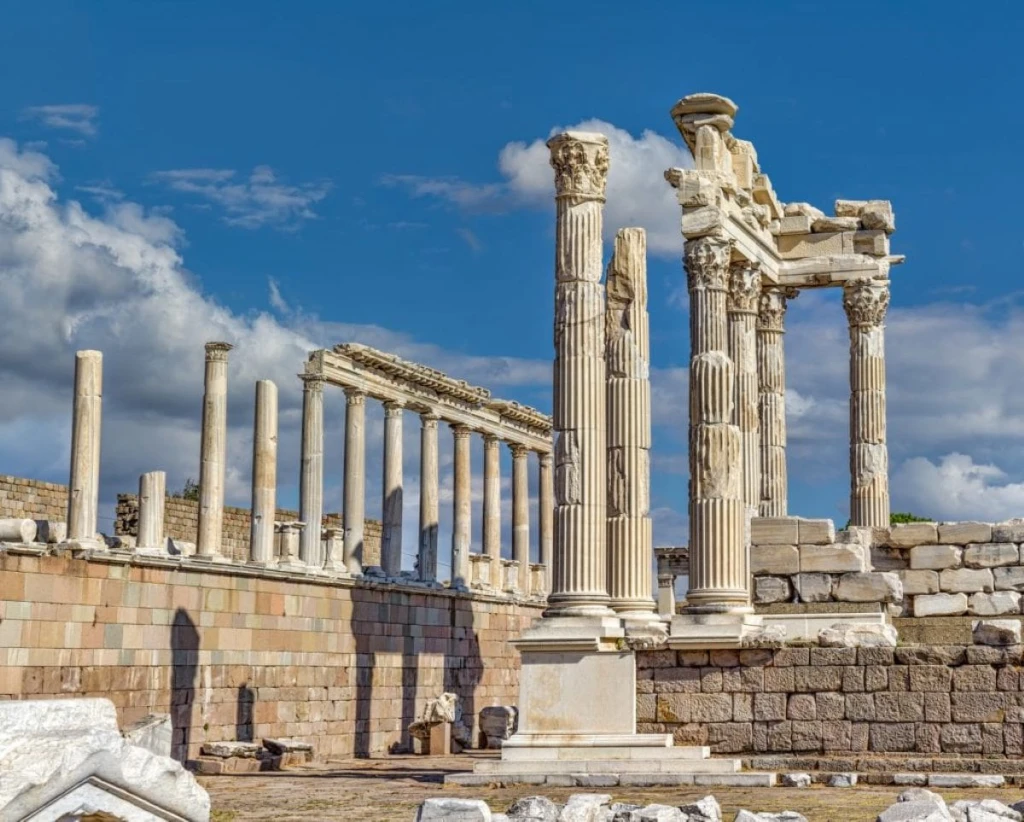
The ancient city of Pergamon was one of the most important cities of the Hellenistic and Roman worlds. Located on the Aegean coast of Anatolia in present-day Bergama, its strategic hilltop position, surrounded by mountains, provided excellent natural defenses, while the nearby Bakırçay River (ancient Caicus River) supplied fertile farmland and abundant water resources.
The first settlers arrived in Pergamon during the 8th century BC and belonged to the Aeolian Greeks.
The Attalid Kingdom
Following the death of Alexander the Great, one of his generals, Lysimachus, selected Pergamon as the place to safeguard an enormous royal treasury.
The treasure was entrusted to Philetaerus, who later used this wealth to establish the Attalid Dynasty, which ruled the region for approximately 150 years.
During this period, Pergamon reached the height of its political, cultural, and artistic prosperity.
Under the reign of Attalus I and his successors, the city became one of the greatest cultural centers of the Mediterranean.
Thanks to its alliance with Rome, the Kingdom of Pergamon expanded its influence across regions including:
- Mysia
- Lydia
- Caria
- Pamphylia
- Phrygia
A Cultural Center of the Ancient World
During the Hellenistic period, Pergamon rivaled some of the greatest cities of antiquity, including:
- Alexandria
- Antioch
The city became famous for its:
- Monumental architecture
- Renowned school of sculpture
- Great library
- Scientific and medical institutions
- Intellectual achievements
In 133 BC, Attalus III bequeathed his kingdom to Rome, and Pergamon became part of the Roman Republic before later joining the Roman Empire.
The Library of Pergamon
The Library of Pergamon was one of the greatest libraries of the ancient world.
It is believed to have housed nearly 200,000 manuscripts.
The three most important libraries of antiquity were:
- Library of Alexandria – approximately 500,000 manuscripts
- Library of Pergamon – approximately 200,000 manuscripts
- Library of Celsus in Ephesus – approximately 12,000 manuscripts
The library featured spacious reading rooms, specially designed shelving systems, and sophisticated ventilation to protect valuable manuscripts from moisture.
The Origin of Parchment
When Egypt prohibited the export of papyrus, Pergamon's scholars searched for an alternative writing material.
They developed parchment, made from carefully treated sheep and goat skins.
In fact, the English word "parchment" derives directly from the name Pergamon, highlighting the city's enormous contribution to the history of writing and knowledge.
The Acropolis of Pergamon
Unlike the Acropolis of Athens, which was primarily religious in purpose, the Acropolis of Pergamon was designed as a political, cultural, and administrative center.
Its magnificent monuments were strategically positioned to impress visitors approaching the city from the valley below.
Highlights of the Acropolis
- Heroon
- Sanctuary of Athena
- Library of Pergamon
- Altar of Zeus
- Agora
- Theater
- Temple of Trajan
The Altar of Zeus
The Altar of Zeus is regarded as one of the masterpieces of Hellenistic architecture.
Built between 180 and 160 BC, it commemorated Pergamon's victory over the Galatians.
Its magnificent sculpted friezes depicted:
- The Gigantomachy (the battle between the Olympian gods and the Giants)
- Scenes from Greek mythology
- Military victories of the Attalid Kingdom
Today, much of the original altar is displayed in the Pergamon Museum in Berlin.
The Theater of Pergamon
The Theater of Pergamon is one of the most spectacular theaters of the ancient world.
Built into the steep hillside of the Acropolis, it is widely recognized as the steepest ancient theater ever constructed.
Highlights include:
- 87 rows of seats
- Seating capacity of approximately 10,000 spectators
- Panoramic views over the valley
- Outstanding Hellenistic engineering
The Temple of Trajan
Built during the 2nd century AD, the Temple of Trajan was dedicated to the Roman Emperor Trajan and later expanded by Emperor Hadrian.
The temple featured elegant Corinthian columns and occupied one of the most prominent positions on the Acropolis.
The Asclepieion: The Ancient Medical Center
One of Pergamon's most celebrated monuments is the Asclepieion, a sanctuary dedicated to Asclepius, the Greek god of medicine.
Founded during the 4th century BC, it became one of the most advanced medical centers of the ancient world.
The famous physician Galen (AD 129)—considered one of the founders of modern medicine—worked and studied here.
Treatments included:
- Hydrotherapy
- Therapeutic baths
- Herbal medicine
- Sun therapy
- Psychological treatments
- Dream interpretation
The Asclepieion is often regarded as one of the world's earliest hospitals.
The Red Basilica
The Red Basilica (Kızıl Avlu) is one of Bergama's most impressive monuments.
Probably built during the reign of Emperor Hadrian, it was originally dedicated to the Egyptian god Serapis.
During the Byzantine period, it was converted into one of the earliest Christian basilicas in Anatolia.
Pergamon Today
Today, Pergamon is one of Turkey's most important archaeological sites and is recognized as a UNESCO World Heritage Site.
Its temples, libraries, theaters, medical centers, and monumental architecture reflect the extraordinary role the city played in the development of Western civilization.
Visiting Pergamon is an unforgettable journey into one of the greatest cultural, scientific, and artistic centers of the ancient world.
Our partners