
 English
 Español
 Português
Pamukkale: Turkey's Cotton Castle

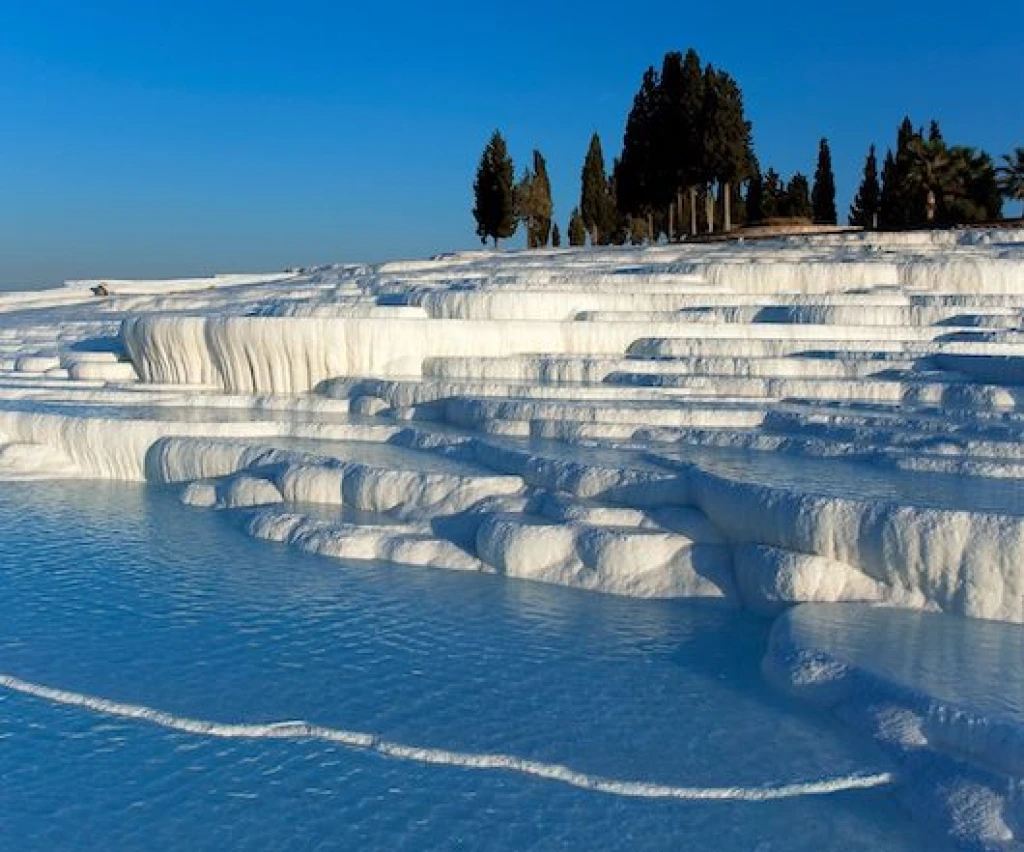
Pamukkale is one of the world's most spectacular natural wonders and one of Turkey's most visited destinations. Its name literally means "Cotton Castle" in Turkish, inspired by the dazzling white travertine terraces that cascade down the hillside.
Recognized as a UNESCO World Heritage Site, Pamukkale combines extraordinary natural beauty with the remarkable archaeological heritage of the ancient city of Hierapolis.
Hierapolis: The Sacred City
The ancient city of Hierapolis was most likely founded during the 2nd century BC by King Eumenes II of Pergamon.
Its name means "Sacred City" in Greek, and it became one of the most important thermal spa centers of the ancient world.
In 133 BC, Hierapolis became part of the Roman Empire, beginning a long period of prosperity thanks to its famous thermal springs.
Throughout its history, the city suffered numerous earthquakes and was rebuilt several times. During the 1st century AD, Emperor Nero ordered an extensive reconstruction of the city.
Pamukkale's White Travertine Terraces
Pamukkale's famous white terraces began forming approximately 14,000 years ago through the region's geothermal activity.
The thermal waters emerge at a temperature of around 35°C (95°F) and contain high concentrations of calcium bicarbonate.
When the water reaches the surface:
- Carbon dioxide escapes into the atmosphere.
- Calcium carbonate precipitates.
- Brilliant white travertine deposits are formed.
Over thousands of years, this natural process created the spectacular stepped pools that attract millions of visitors every year.
Karahayıt and the Red Thermal Springs
Just a few kilometers from Pamukkale lies the town of Karahayıt.
Its thermal springs are known as "Red Water" (Kırmızı Su) because of their striking reddish color, created by their rich mineral content.
Karahayıt's waters are even hotter than those of Pamukkale and have been used for therapeutic purposes for centuries.
The Necropolis of Hierapolis
One of Hierapolis' most impressive monuments is its vast Necropolis, considered one of the largest ancient cemeteries in Anatolia.
It contains more than 1,000 tombs, including:
- Sarcophagi
- Mausoleums
- Family tombs
- Monumental burial structures
The remarkable number of tombs reflects Hierapolis' fame as an important center for healing and religious pilgrimage.
The Martyrdom of Saint Philip
Hierapolis occupies an important place in the history of Christianity.
According to Christian tradition, Saint Philip the Apostle was martyred here around AD 80.
During the 5th century, the impressive Martyrium of Saint Philip was built over the site traditionally believed to be his place of martyrdom.
The octagonal complex included:
- A central chamber
- Eight surrounding halls
- A sacred crypt
- Pilgrimage areas
Many early Christians wished to be buried near the apostle, explaining the large number of Christian tombs found within the Necropolis.
The Roman Theater
The Theater of Hierapolis is one of the best-preserved Roman theaters in Turkey.
Originally constructed during the 2nd century AD and later expanded under Emperor Septimius Severus, it could accommodate thousands of spectators.
Highlights include:
- A magnificent decorated stage
- Mythological reliefs
- Sculptures dedicated to Dionysus
- Outstanding preservation
Today, it remains one of Turkey's most impressive Roman monuments.
The Temple of Apollo
The Temple of Apollo was built during the 3rd century AD.
Beneath the temple lay a natural cave that emitted toxic gases from deep underground.
Ancient people believed this mysterious cave was an entrance to the Underworld.
Pluto's Gate (The Ploutonion)
Next to the temple stood the famous Ploutonion, a sacred grotto believed to be the gateway to the realm of Pluto, the god of the Underworld.
The Greek geographer Strabo described it as an opening that released deadly vapors capable of killing animals that approached too closely.
Today, scientists know these gases consist primarily of naturally occurring carbon dioxide produced by the region's geothermal activity.
Cleopatra's Antique Pool
One of Pamukkale's most popular attractions is the famous Cleopatra's Antique Pool.
Visitors can swim among:
- Natural thermal waters
- Submerged Roman columns
- Ancient archaeological remains displaced by historic earthquakes
The pool offers a unique opportunity to enjoy mineral-rich thermal waters surrounded by centuries of history.
The Hierapolis Archaeological Museum
The Hierapolis Archaeological Museum is housed inside a beautifully restored 2nd-century Roman bath complex.
Its collections include:
- Roman sculptures
- Sarcophagi
- Ancient reliefs
- Funerary artifacts
- Archaeological discoveries from Hierapolis and the surrounding region
The museum provides valuable insight into the history and culture of ancient western Anatolia.
A Unique Destination in Turkey
Pamukkale is one of Turkey's most extraordinary destinations, perfectly combining nature, history, archaeology, and culture.
Its dazzling white terraces, the magnificent ruins of Hierapolis, therapeutic thermal waters, and remarkably preserved Roman monuments make it an essential destination for anyone wishing to discover the wonders of Anatolia.
A visit to Pamukkale offers an unforgettable journey through one of Turkey's most iconic UNESCO World Heritage Sites.
Our partners