
 English
 Español
 Português
Göreme Open-Air Museum

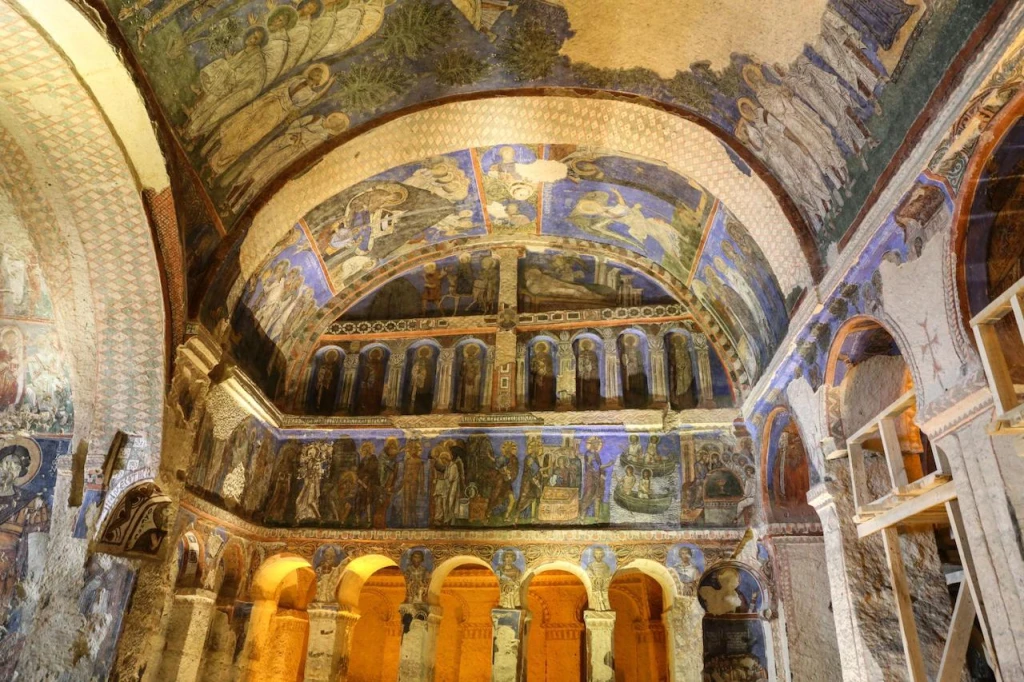
The Göreme Open-Air Museum is one of Cappadocia's greatest treasures and one of the most important monastic complexes of early Christianity. Recognized as a UNESCO World Heritage Site, this extraordinary collection of rock-cut churches, chapels, monasteries, and religious buildings offers a unique insight into the spiritual life that flourished in the region for centuries.
The First Christians in Cappadocia
During the early centuries of Christianity, many believers chose to live as hermits, withdrawing from everyday life to devote themselves entirely to prayer, meditation, and spiritual reflection. Although they were not formally attached to monasteries or churches, they were respected and supported by local Christian communities.
By the end of the 2nd century AD, Cappadocia had already become an important Christian center, with two major bishoprics located in Caesarea (Kayseri) and Malatya. During the 3rd century, Christianity continued to spread throughout the region, and by the 4th century, Cappadocia gained worldwide religious significance through the influence of the Three Cappadocian Fathers:
- Saint Basil the Great (329–379)
- Saint Gregory of Nyssa (335–394)
- Saint Gregory of Nazianzus (329–394)
Saint Basil and the Birth of Monasticism in Cappadocia
Born into a wealthy Cappadocian family, Saint Basil the Great studied in Constantinople and Athens before visiting the famous monasteries of Egypt and Syria.
Inspired by what he experienced, he returned to Anatolia determined to establish a new form of monastic life based on community living, mutual support, prayer, education, and service to others.
Saint Basil became one of the founders of organized Christian monasticism. He encouraged monks to live, work, and worship together while also promoting the establishment of hospitals, schools, and charitable institutions for the poor and the sick.
Many churches throughout Cappadocia depict Saint Basil in their apses as a symbol of his profound spiritual influence.
The Göreme Open-Air Museum is considered one of the places where this distinctive monastic tradition first developed before spreading to other parts of Cappadocia, including Soğanlı Valley, Ihlara Valley, and Açık Saray.
Saint George of Cappadocia
Saint George, one of Christianity's most beloved saints, also has deep historical connections with Cappadocia.
He served as an officer in the Roman army and was persecuted during the reign of Emperor Diocletian for refusing to renounce his Christian faith.
According to Christian tradition, he endured severe torture before being executed in AD 303. Centuries later, the famous legend of Saint George and the Dragon emerged, becoming one of the best-known stories in Christian history.
Highlights of the Göreme Open-Air Museum
Today, the Göreme Open-Air Museum is one of Turkey's most visited attractions. Located approximately 1 kilometer (0.6 miles) from the center of Göreme, it preserves some of the finest examples of rock-cut religious architecture in the world.
Nuns' Monastery (Rahibeler Monastery)
An impressive multi-level monastery carved into a massive rock formation, featuring living quarters, kitchens, dining halls, and a small church decorated with medieval paintings.
Saint Basil's Chapel
Built during the 11th century, this chapel contains beautiful depictions of Christ, the Virgin Mary, Saint George, and other important saints of Eastern Christianity.
Elmalı Church (Apple Church)
One of the museum's most famous churches, admired for its cross-shaped architecture and magnificent frescoes illustrating scenes from both the Old and New Testaments.
Saint Barbara Chapel
Known for its striking red geometric decorations and symbolic motifs, this church combines Byzantine religious art with distinctive local artistic traditions.
Yılanlı Church (Snake Church)
Famous for its frescoes depicting prominent Christian saints, including Saint George, Saint Helena, and Emperor Constantine.
Dark Church (Karanlık Kilise)
Considered the masterpiece of the museum, the Dark Church owes its name to the very limited natural light entering the interior. As a result, its Byzantine frescoes have retained their extraordinary colors for nearly a thousand years.
Among the scenes depicted are:
- The Nativity of Christ
- The Last Supper
- The Crucifixion
- The Transfiguration
- Christ's Entry into Jerusalem
- The Last Judgment
Saint Catherine's Chapel
A small rock-cut church preserving remarkable examples of Byzantine architecture and decorative artwork.
Çarıklı Church (Sandal Church)
Located near the end of the museum route, this church forms part of a monastic complex and contains some of the best-preserved frescoes in all of Cappadocia.
A Unique Museum in the World
The Göreme Open-Air Museum represents one of the world's greatest collections of Byzantine Christian art and religious architecture.
Its rock-cut churches, monasteries, and magnificent frescoes tell the story of Cappadocia's rich spiritual heritage and explain why this extraordinary region became one of the most important centers of Eastern Christianity for centuries.
Visiting the Göreme Open-Air Museum is a journey into the heart of Cappadocia's history, faith, art, and cultural heritage—an unforgettable experience for every traveler exploring Turkey.
Architecture of the Churches of Göreme
The rock-cut churches of Göreme represent some of the finest examples of Christian art and architecture in Cappadocia. Built between the 9th and 13th centuries, these remarkable monuments reflect the development of monastic life and religious traditions in the region during the Byzantine period.
The Architecture of Göreme's Churches
The most common church design in Göreme is the single-nave church covered by a barrel vault. This simple architectural style was ideal for the small monastic communities that lived in isolation among Cappadocia's valleys. Many of these churches also served as burial chapels.
Another common design is the Greek Cross plan, characterized by a symmetrical layout with domes carved directly into the volcanic rock. This architectural style reached its highest level of development during the Middle Byzantine period.
Two-nave churches are relatively rare in Göreme. One notable example is the Church of Saint Eustathius. This architectural style is more frequently found in the Soğanlı and Ihlara Valleys.
Three-nave basilicas are even rarer because carving such large structures into the volcanic rock required tremendous skill and effort. These churches were generally larger and more elaborate, featuring three apses and multiple altars used for different religious ceremonies.
Painting Techniques
The artists of Cappadocia employed two principal techniques to decorate the churches.
Painting Directly on the Rock
The earliest method involved applying natural pigments directly onto the rock surface using mineral-based and plant-derived colors.
These decorations are mainly found in churches dating from the Byzantine Iconoclastic Period and typically include:
- Maltese crosses
- Geometric motifs
- Floral patterns
- Simple Christian symbols
Over time, many of these paintings were covered with plaster and replaced by richly detailed biblical frescoes.
Excellent examples of this early decorative style can be seen in:
- Tokalı Church
- Saint Basil's Chapel
- Elmalı Church
- Saint Barbara Chapel
- Fish Church in Zelve
- Fırkatan Church in Ortahisar
Fresco Painting
The second technique involved applying pigments onto freshly laid wet plaster using the true fresco method.
This process produced more detailed and durable artwork, allowing the colors to become permanently bonded with the wall surface.
After completion, the frescoes were coated with a protective finish made from natural plant-based substances, enhancing both their brilliance and long-term preservation.
Themes of the Frescoes
The frescoes of Göreme primarily illustrate:
- The life of Jesus Christ
- Scenes from the Old and New Testaments
- The Virgin Mary
- The Apostles
- Christian saints
- Important religious figures of Cappadocia
The most significant compositions are generally located within the domes and apses, while the side walls depict narrative scenes from the Bible.
One of the most common artistic themes is the Deesis, portraying Christ flanked by the Virgin Mary and Saint John the Baptist.
Nuns' Monastery (Rahibeler Monastery)
Located near the entrance of the Göreme Open-Air Museum, the Nuns' Monastery was carved into a massive six-story rock formation.
Inside visitors can explore:
- Kitchen
- Dining hall
- Monastic living quarters
- A small chapel
- A church built in AD 1055
Frescoes of Christ and decorative paintings in red and green tones can still be admired today.
Saint Basil's Chapel
Built during the 11th century, this chapel has a rectangular floor plan with three apses.
Its walls display beautiful images of:
- The Virgin Mary and Child
- Saint Demetrius
- Saint George
- Saint Theodore
Several frescoes depict mounted warrior saints fighting against evil, a popular subject in Cappadocian Byzantine art.
Elmalı Church (Apple Church)
Elmalı Church is one of the museum's most significant monuments.
Its Greek Cross floor plan is supported by four massive columns known in Turkish architecture as "elephant feet."
Among its finest frescoes are:
- The Hospitality of Abraham
- The Three Hebrew Youths in the Fiery Furnace
- Scenes from the Life of Christ
- Numerous biblical episodes
Ironically, because the church served as a pigeon house for centuries, many of its frescoes survived in remarkably good condition.
Saint Barbara Chapel
Dedicated to Saint Barbara, this chapel is distinguished by its striking geometric decorations painted in vivid red.
Its principal images include:
- Christ in the central apse
- Saint George
- Saint Theodore
- Saint Barbara
The simplicity of some decorative elements suggests they may have been created by apprentice painters or local artists.
Yılanlı Church (Snake Church)
This church derives its name from symbolic representations associated with snakes.
Its frescoes portray:
- Saint Onuphrius
- Saint Basil
- Saint Thomas
- Saint George
- Saint Theodore
- Saint Helena with the True Cross
- Emperor Constantine
Kitchen, Pantry, and Refectory
Adjacent to Yılanlı Church are the communal facilities once used by the monastic community for everyday life.
Visitors can still see:
- Traditional ovens
- Food storage areas
- Stone benches
- Communal dining tables
- Wine production facilities
Dark Church (Karanlık Kilise)
The Dark Church is widely regarded as the masterpiece of the Göreme Open-Air Museum.
It receives its name because only a small window allows natural light into the interior. As a result, its magnificent frescoes have remained exceptionally well preserved.
The church features:
- A Greek Cross floor plan
- Six domes
- Three apses
- Four massive supporting columns
Following a ten-year restoration project completed in 1986, its frescoes once again revealed some of the finest masterpieces of Byzantine art, including:
- The Nativity of Christ
- The Last Supper
- Christ's Entry into Jerusalem
- The Crucifixion
- The Transfiguration
- The Deesis
- The Hospitality of Abraham
Çarıklı Church (Sandal Church)
Located near the end of the museum route, Çarıklı Church forms part of a two-story monastic complex.
The church contains:
- Four domes
- Two columns
- Three apses
Its frescoes closely resemble those found in Elmalı Church and the Dark Church.
One particularly intriguing image portrays a figure wearing a turban, whom some historians believe represents the Seljuk Sultan Mesud II, reflecting the cultural coexistence that characterized Cappadocia for centuries.
A Masterpiece of Byzantine Art
The churches of Göreme constitute one of the world's most significant collections of medieval Christian art.
Their remarkable rock-cut architecture and extraordinarily preserved Byzantine frescoes make the Göreme Open-Air Museum an essential destination for anyone wishing to understand the history, spirituality, artistic heritage, and cultural legacy of Cappadocia.
Churches Around the Göreme Open-Air Museum
In addition to the churches located within the Göreme Open-Air Museum, numerous rock-cut churches are scattered throughout the surrounding valleys and hills. These remarkable monuments represent some of the finest examples of Byzantine art in Cappadocia and provide valuable insight into the evolution of the region's religious architecture.
Among the most important are Tokalı Church, Saint Eustathius Church, Saint Daniel's Chapel, The Church of the Virgin Mary, Kılıçlar Church, El Nazar Church, Saklı Church, and Aynalı Church.
Tokalı Church (Tokalı Kilise)
Located just a few meters from the entrance to the Göreme Open-Air Museum, Tokalı Church is considered one of the most important churches in all of Cappadocia.
Its magnificent frescoes, exceptional artistic quality, and harmonious use of color represent the highest achievement of what historians call Cappadocian Art.
The complex consists of four main sections:
- The Old Church
- The New Church
- A lower church connected by stairways
- A side chapel
The most significant frescoes are found inside both the Old Church and the New Church.
The Old Church
The frescoes in this section were painted during the 10th century and illustrate numerous episodes from the life of Jesus Christ. Their artistic style reflects the distinctive local traditions of Cappadocian Byzantine painting.
The New Church
The New Church is especially famous for its remarkable use of vivid blue pigments, rarely seen in other churches throughout the region.
Its rectangular plan ends in three apses supported by elegant columns. The frescoes mainly depict scenes from the life of Jesus Christ and Saint Basil the Great.
Created between the 10th and 11th centuries, these paintings are regarded as masterpieces of Byzantine art in Anatolia.
Saint Eustathius Church (Aziz Eustathios Church)
This church is reached by following a trail leading from Tokalı Church.
Its entrance is located approximately 4 meters (13 feet) above ground and is accessed by a staircase carved directly into the rock.
The church features:
- A rectangular floor plan
- A single apse
- A central altar
- An additional funerary chapel
An inscription carved into the wall states that the church was built in AD 1148.
The frescoes are dominated by green and red tones, with an especially impressive depiction of Saint Eustathius beside the main apse.
Saint Daniel's Chapel
Located close to Saint Eustathius Church, this small chapel takes its name from frescoes depicting the Prophet Daniel in the Lions' Den.
Its simple architecture includes:
- A rectangular floor plan
- A single apse
- Byzantine painted decoration
Most of the frescoes date from the 11th century, although some decorative elements appear to originate from the Byzantine Iconoclastic Period.
Church of the Virgin Mary (Meryem Ana Church)
This church is located approximately 250 meters (820 feet) from the main road, along the path leading from Tokalı Church.
It is also known as Kılıçlar Kuşluk Church.
Its elevated position offers magnificent panoramic views over Kılıçlar Valley.
The church features:
- A rectangular floor plan
- Three apses
- A long entrance corridor
The right apse has suffered considerable damage due to natural erosion.
Its frescoes depict:
- The Journey to Bethlehem
- The Nativity of Christ
- The Crucifixion
- The Dormition of the Virgin Mary
The church also contains an important portrait of Saint Basil the Great, one of the Three Cappadocian Fathers.
Kılıçlar Church
Kılıçlar Church takes its name from the valley in which it is located.
It stands approximately 600 meters (0.4 miles) northeast of the Göreme Open-Air Museum entrance.
The church was carved with:
- A closed Greek Cross floor plan
- Three apses
- A central dome supported by four pillars
Its frescoes date mainly from the 9th and 10th centuries and represent one of the oldest surviving painted ensembles in Cappadocia.
El Nazar Church
El Nazar Church is one of Cappadocia's most distinctive rock-cut churches.
Visitors reach the church by following a footpath through an old vineyard.
Unlike most churches in the region, it was carved directly into a cone-shaped Fairy Chimney, making it architecturally unique.
Part of the monument has been carefully restored to preserve its historical character.
The frescoes, painted between the 11th and 12th centuries, follow a chronological narrative of the life of Christ.
Among the scenes depicted are:
- The Annunciation
- The Visitation of Mary to Elizabeth
- The Nativity of Jesus
- The Baptism of Christ
- Christ's Entry into Jerusalem
- The Ascension
The walls also preserve numerous images of saints and biblical figures.
A Hidden Treasure of Cappadocia
The churches surrounding the Göreme Open-Air Museum perfectly complement a visit to the museum itself.
Their beautifully preserved frescoes, remarkable rock-cut architecture, and outstanding historical significance make this area one of the world's greatest collections of medieval Christian art.
Exploring these hidden churches offers visitors a deeper understanding of the spiritual, artistic, and cultural heritage that made Cappadocia one of the most important centers of Eastern Christianity for more than a thousand years.
Our partners