
 English
 Español
 Português
Ephesus

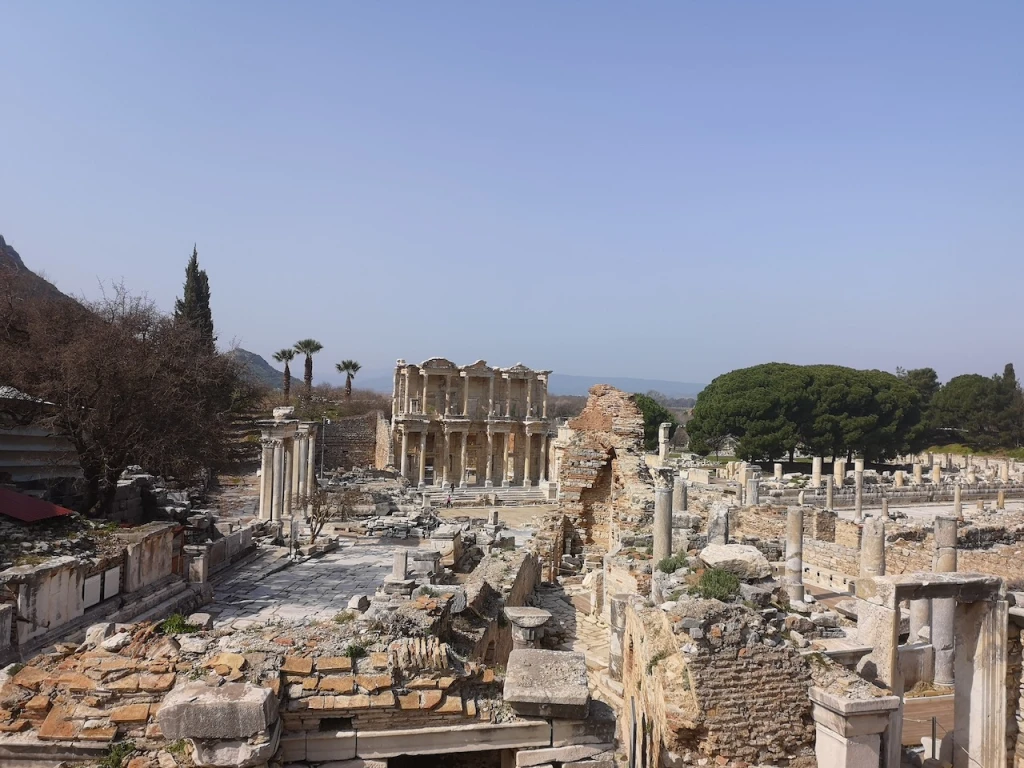
Ephesus: The Best-Preserved Ancient City in Turkey
Ephesus is one of the world's most spectacular archaeological sites and one of the best-preserved ancient cities in the Mediterranean. Located near the modern town of Selçuk on Turkey's Aegean coast, it was one of the most important commercial, cultural, and religious centers of the ancient world.
During the Roman period, Ephesus became the second-largest city of the Roman Empire after Rome, with an estimated population of more than 250,000 inhabitants.
Today, its remarkably preserved monuments allow visitors to step back more than two thousand years into history.
The Legend of the Founding of Ephesus
According to Greek mythology, the founding of Ephesus is connected to a prophecy from the Oracle of Delphi.
Androclus, the son of King Codrus of Athens, consulted the oracle to discover where he should establish a new city.
The oracle gave him a mysterious answer:
"A fish and a wild boar will show you the place."
While exploring the Anatolian coast, Androclus and his companions were cooking fish when a spark ignited nearby bushes. A wild boar suddenly ran out from the flames.
Believing this to be the sign foretold by the oracle, Androclus founded the city of Ephesus on that very spot.
History of Ephesus
Throughout its long history, Ephesus was ruled by many great civilizations, including:
- The Hittites
- The Lydians
- The Persians
- The Greeks
- The Macedonians
- The Kingdom of Pergamon
- The Romans
- The Byzantines
In 133 BC, Ephesus became part of the Roman Empire and was designated the capital of the Roman Province of Asia.
Its busy harbor connected the East with the Mediterranean, making the city one of the empire's most important commercial centers.
Walking Tour of Ancient Ephesus
Most visits begin at the Magnesia Gate, located at the upper entrance of the archaeological site.
Magnesia Gate
The Magnesia Gate served as the eastern entrance to the city.
Its design featured:
- Three main entrances
- Separate pedestrian access
- A central passage for carts and horses
- A double-gate defensive system
Varius Baths
Dating from the 2nd century AD, the Varius Baths showcase the sophistication of Roman public bathing culture.
The complex included:
- Frigidarium (cold room)
- Tepidarium (warm room)
- Caldarium (hot room)
Odeon (Bouleuterion)
The Odeon, also known as the Bouleuterion, was a small covered theater used for:
- Political meetings
- City council sessions
- Concerts
- Official ceremonies
Built during the 2nd century AD, it accommodated approximately 1,500 spectators.
State Agora
The State Agora served as the political and administrative center of Ephesus.
Surrounded by monumental colonnades, it hosted government offices, official ceremonies, and public administration.
Prytaneion
The Prytaneion was one of the city's most important civic buildings.
It contained:
- Administrative offices
- Meeting halls
- Public archives
- Official dining rooms
At its center burned the Sacred Flame of Hestia, continuously maintained by priests known as the Curetes.
Temple of Domitian
The Temple of Domitian was among the first temples in Asia Minor dedicated to a Roman emperor.
It symbolized Ephesus' loyalty to Rome and the imperial family.
Fountain of Trajan
Built during the 2nd century AD, the elegant Fountain of Trajan was richly decorated with statues of gods and members of the imperial family.
A colossal statue of Emperor Trajan once dominated the monument.
Today, only the emperor's enormous marble feet remain.
Scholastica Baths and the Public Latrines
The Scholastica Baths were restored during the 5th century by a wealthy Christian woman named Scholastica.
Adjacent to the baths are the famous Roman public toilets, considered among the best-preserved public latrines in the ancient world.
The Brothel of Ephesus
Located beside Marble Street, the Brothel of Ephesus offers a fascinating glimpse into daily Roman life.
A famous engraving on the pavement depicts:
- A footprint
- A heart
- The face of a woman
Many historians consider it to be one of the world's earliest forms of advertising.
Temple of Hadrian
Dedicated to Emperor Hadrian, this elegant monument is one of the most photographed buildings in Ephesus.
Its beautifully decorated Corinthian façade and mythological reliefs make it one of the city's architectural masterpieces.
Terrace Houses
The magnificent Terrace Houses belonged to the wealthiest families of Ephesus.
These luxurious residences featured:
- Central heating systems
- Colorful frescoes
- Intricate mosaics
- Private bathrooms
- Elegant reception halls
They are considered among the finest examples of Roman residential architecture ever discovered.
Hercules Gate
The Hercules Gate marked the boundary between the pedestrian district and areas accessible to wheeled traffic.
Its reliefs depict the legendary hero Hercules wearing the skin of the Nemean Lion.
Library of Celsus
The Library of Celsus is the most famous monument in Ephesus and one of the greatest architectural masterpieces of the Roman world.
Built during the 2nd century AD by Gaius Julius Aquila in honor of his father, the Roman governor Tiberius Julius Celsus Polemaeanus, the library became a symbol of learning and culture.
Highlights include:
- Monumental two-story façade
- Corinthian columns
- Statues representing Wisdom, Knowledge, Intelligence, and Virtue
- Capacity for approximately 12,000 manuscripts
Today, the Library of Celsus is the iconic symbol of Ephesus and one of Turkey's most recognizable archaeological landmarks.
Commercial Agora
The Commercial Agora was the economic heart of ancient Ephesus.
It served as the center for:
- Trade
- Markets
- Business meetings
- International commerce
Its proximity to the harbor made it one of the busiest marketplaces in the Roman Empire.
Marble Street
Marble Street connected the Library of Celsus with the Great Theatre.
Completely paved with marble, it was one of the city's principal avenues and an impressive example of Roman urban planning.
Great Theatre of Ephesus
The Great Theatre is one of the finest ancient theaters in the world.
Its features include:
- Originally built during the 3rd century BC
- Expanded during the Roman period
- Seating capacity of approximately 24,000 spectators
- Three impressive seating tiers
The theater hosted:
- Dramatic performances
- Concerts
- Public assemblies
- Political events
It is also famous as the place where Saint Paul preached during his stay in Ephesus.
Harbor Street (Arcadian Way)
The magnificent Arcadian Way connected the harbor to the city center.
This grand avenue featured:
- Marble colonnades
- Street lighting during the Roman period
- Shops
- Public buildings
For travelers arriving by sea, it provided a spectacular first impression of the grandeur of Ephesus.
A World-Class Archaeological Treasure
Ephesus represents one of the greatest examples of Roman urban planning and is an essential destination for anyone interested in the history of Turkey and the ancient world.
Walking along its marble streets, admiring the magnificent Library of Celsus, and sitting in the seats of the Great Theatre allows visitors to experience the remarkable legacy of one of history's greatest ancient cities.
Our partners