
 English
 Español
 Português
Cappadocia During the Byzantine Empire and the Turkish Period

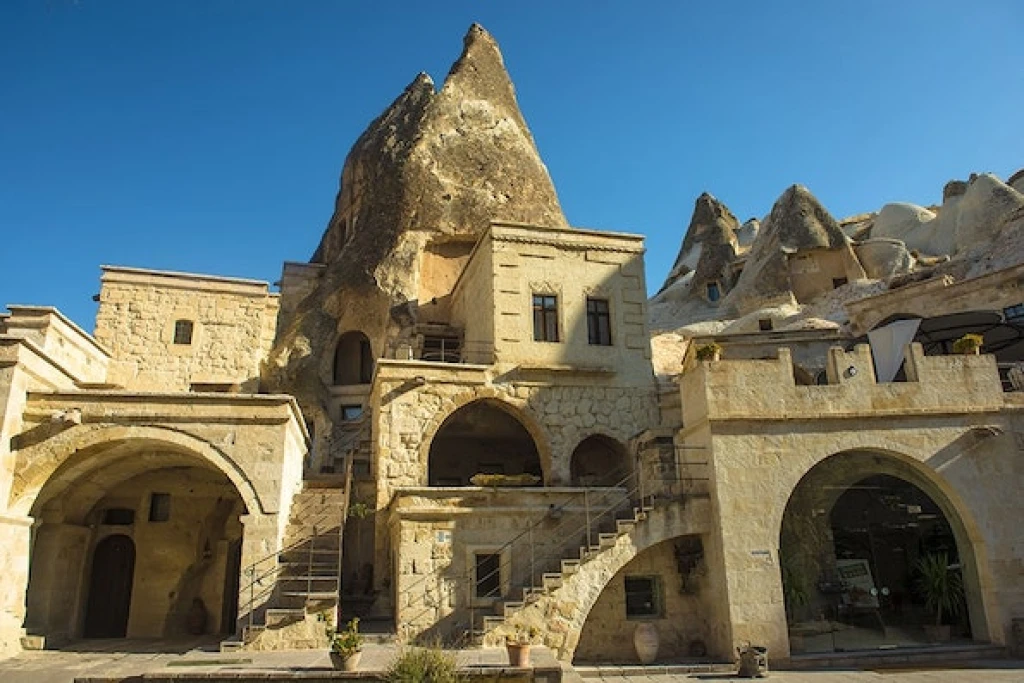
After the division of the Roman Empire into two parts in 395, the region of Cappadocia became part of the Eastern Roman Empire, whose capital was Constantinople (modern-day Istanbul). The early years of the Byzantine period were marked by religious conflicts and disputes among different sects.
During this time, the Sassanids were located on the eastern frontier of the Byzantine Empire. The Sassanid dynasty, which ruled territories including present-day Iran and Iraq between 226 and 651, initially fought against the Romans and later against the Byzantines. In 608, the Sassanid king Khosrow II attacked the Byzantines and captured Kayseri. The Sassanids lost Kayseri and were expelled in 611, but in 626 they reconquered the city and continued their military campaigns.
The so-called period of the Four Caliphs in Islamic history marked the end of the Sassanid Empire, which disappeared completely in 651. The fall of the Sassanids meant the disappearance of one of the Byzantines’ most important enemies. However, the Umayyads, of Arab origin and based in Damascus (661–750), and later the Abbasids (750–1258), quickly became the new adversaries of the Byzantine Empire.
The Umayyads attacked Cappadocia in 709 and captured the city of Tyana. The attacks continued until 713, and much of Cappadocia came under Arab control. In 726, Kayseri was attacked again. Christians in the region began to take refuge once more in underground cities and caves to protect themselves from invasions and to freely practice their faith. As a result, the number of rock-cut churches increased significantly.
In 726, the Byzantine emperor Leo III managed to expel the Arabs from Kayseri and recover territories as far as Malatya. That same emperor banned the use of icons and religious images in churches. This period, known as Iconoclasm, lasted from 726 to 843. In 843, Empress Theodora officially restored the veneration of icons.
The reasons for this prohibition included the intention to reduce the influence of the clergy over the government and to prevent excessive veneration of religious images. The influence of Islam was also an important factor. During Iconoclasm, there were no major military conflicts, but many defenders of icons took refuge in the rocky areas of Cappadocia, where they built churches decorated with religious images. As a result, the number of rock-cut churches in the region increased significantly. More than 400 churches were built in the surroundings of Göreme alone.
During the Abbasid period, Byzantium continued to suffer Arab attacks, although military pressure in the region gradually decreased.
The Seljuks (1040–1318)
The Great Seljuk Empire (1040–1157), founded by the Turks and mainly established around present-day Iran, was the eastern neighbor of the Byzantine Empire. Later, the Seljuks adopted Islam, which facilitated the expansion of Turkish peoples into Anatolia.
After the victory of Alp Arslan, Sultan of the Seljuk Empire, over the Byzantine emperor Romanos IV Diogenes at the Battle of Manzikert (Malazgirt) in 1071, Byzantine power in Anatolia weakened considerably. As a result, the gates of Anatolia were opened to the Turkish peoples.
Alp Arslan allowed his generals to establish independent principalities in former Byzantine territories. One of these was the Danishmendids (1086–1178), who ruled parts of central and northern Anatolia. The Danishmendids fought alongside the Seljuks against the Crusaders, although they were later absorbed by the Seljuks themselves. Their architectural works can still be seen, especially in Kayseri.
During the period of the Great Seljuk Empire, Suleiman Shah was tasked with conquering Anatolia. He achieved numerous successes and conquered vast territories in a short time. He founded the Seljuk Sultanate of Rum (1078–1318), with its capital in İznik.
After the death of Sultan Sanjar in 1157, the empire began to disintegrate. At that time, the Mongols, who dominated the region of Iran, emerged as a new threat to Anatolia. Eventually, the Seljuk Sultanate of Rum disappeared completely in 1318.
During the Seljuk period, numerous mosques, madrasas, mausoleums, inns, and caravanserais were built, many of which are now part of Turkey’s historical heritage.
The Mongols in Cappadocia (1318–1398)
After the fall of the Seljuk Sultanate of Rum, various Turkish principalities established during the Seljuk period continued to exist. Among them was the Kayı Beylik, which would later give rise to the Ottoman Empire.
During this period, Mongol influence remained significant in Anatolia. In 1318, the Mongols appointed Timurtaş as governor of Anatolia. During his rule, the regional capital was moved from Sivas to Kayseri.
Over time, Timurtaş accumulated enough power to declare his independence. After his death in 1327, a power vacuum emerged, which was taken advantage of by Eretna Bey, who seized control of the region and declared his independence in 1343.
In 1365, the Karamanoğlu dynasty managed to take control of Nevşehir during its ongoing conflicts with the Eretna State and later extended its dominance over much of the Cappadocia region.
Our partners